
This post contains affiliate links. Full disclosure at the bottom of the page.
Explore our Final Day highlights:
Piazza Venezia: The majestic Altare della Patria
Saying Goodbye: Easy transit to Ciampino Airport
We spent our last morning in Rome close to our accommodation, linking together several famous landmarks that lie relatively near one another into a relaxed walk: the Colosseum, the area around the Forum Romanum, Capitoline Hill (Campidoglio), and Piazza Venezia.
Fitting in so many iconic sights in a single morning was only possible because we didn’t go inside any of them – we admired everything from the outside. For us, this is what sightseeing in Rome was all about: walking at an easy, stroller-friendly pace, allowing my husband to get a broad impression of Rome’s most iconic landmarks, without rushing or following an overly packed itinerary.
We checked out of our accommodation around 9 a.m. and left our suitcases in the designated luggage storage area. This made a huge difference, as we could start our walk without carrying any bags.
If your accommodation doesn’t offer this service, I highly recommend using RadicalStorage. They have several verified spots near the Colosseum and Termini Station, which is a lifesaver when traveling with a stroller.
We then walked to a pleasant breakfast spot called Polveriera, located just a stone’s throw from the Colosseum. That morning, the sun was shining beautifully. The city was still quiet, with relatively few people around, which made stopping for breakfast especially calm and enjoyable.
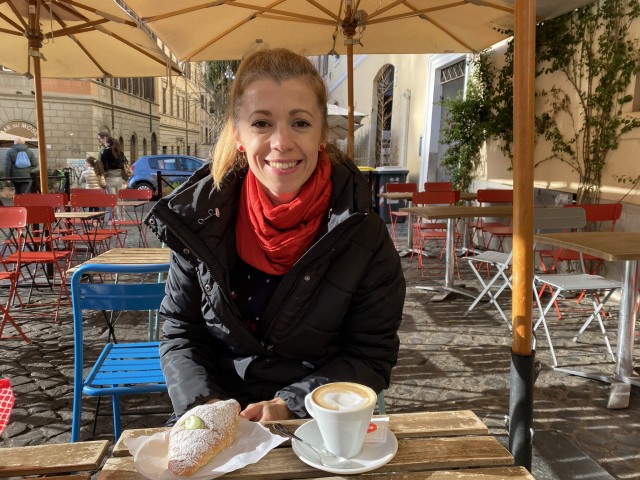
We opted for a classic Italian breakfast: croissants and coffee. It was a lovely bonus that my husband could also find a dairy-free option. The food was delicious, and the service was particularly kind and attentive. In our opinion, this place deserves a better rating than it currently has, as its location is simply perfect – an ideal choice if you’d like to enjoy a relaxed breakfast or coffee before or after visiting the Colosseum. Both indoor and outdoor seating are available. Since the sun was warming the terrace so nicely, we chose an outdoor table and truly enjoyed lingering there in the gentle morning sunshine.
Prices were also very reasonable, and we genuinely enjoyed our breakfast.
For those traveling with young children, this area gets an extra point: it’s easy to navigate with a stroller, and after breakfast you can immediately begin your walk through one of Rome’s most iconic neighborhoods.
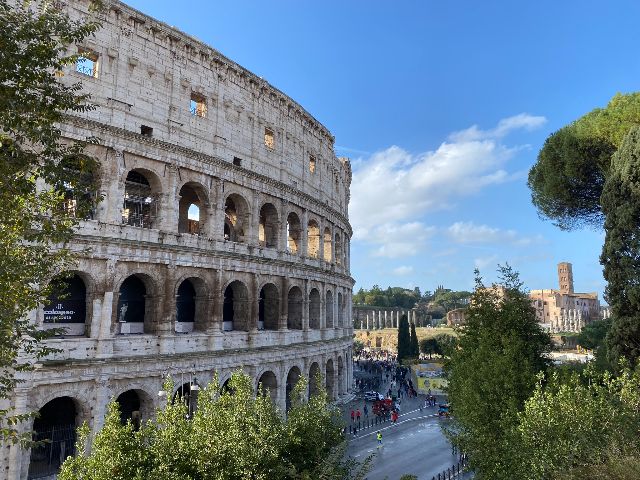
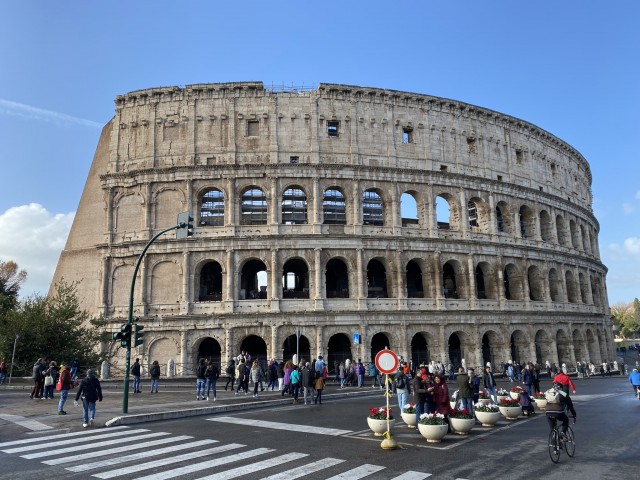
Our first stop after breakfast was the Colosseum, one of Rome’s most recognizable symbols and the largest surviving ancient amphitheater in the world. Although it was built more than 2,000 years ago, it remains an awe-inspiring sight and is rightly considered one of the most significant achievements of Roman architecture.
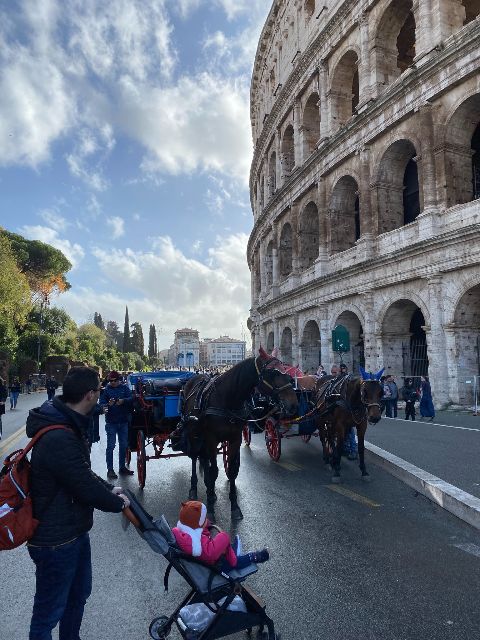
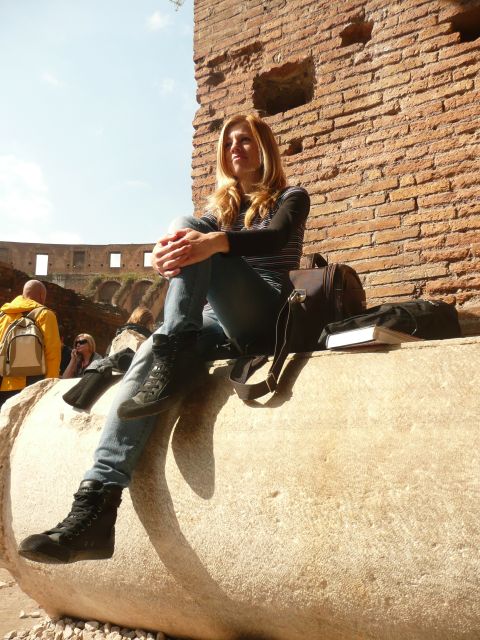
The Colosseum is truly monumental in scale: it measures 189 meters in length, 156 meters in width, and stands 48 meters high. Construction took place between AD 70 and 80, during the reign of Emperor Vespasian and his son Titus. Its capacity was astonishing – it could accommodate between 50,000 and 80,000 spectators at a time.
What was it used for?
The Colosseum was the center of mass entertainment in ancient Rome. Gladiator fights, animal hunts, and various public spectacles were held here. Spectators were seated according to a strict social hierarchy: the emperor and senators occupied the best seats, while women and the poorer classes were placed in the upper tiers. This seating arrangement clearly reflected the social structure of ancient Roman society.
Architectural highlights
The Colosseum has an elliptical shape and is surrounded by arcaded arches on three levels. Beneath the arena lay an extremely complex underground system, known as the hypogeum, where animals and fighters were kept before the shows. The arena floor was once covered with wooden planks and sprinkled with sand – this is where the Latin word arena, meaning “sand,” originates.
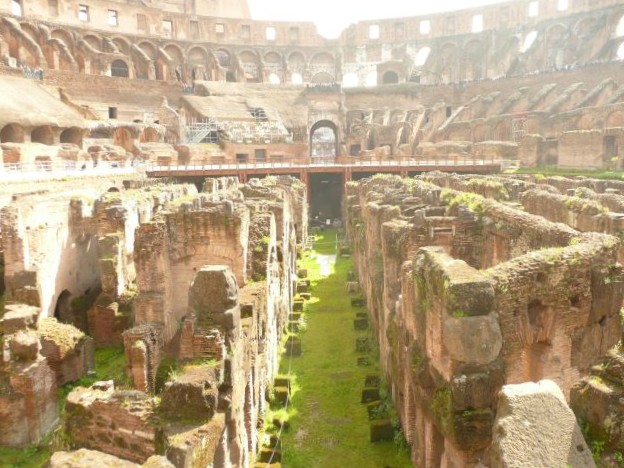
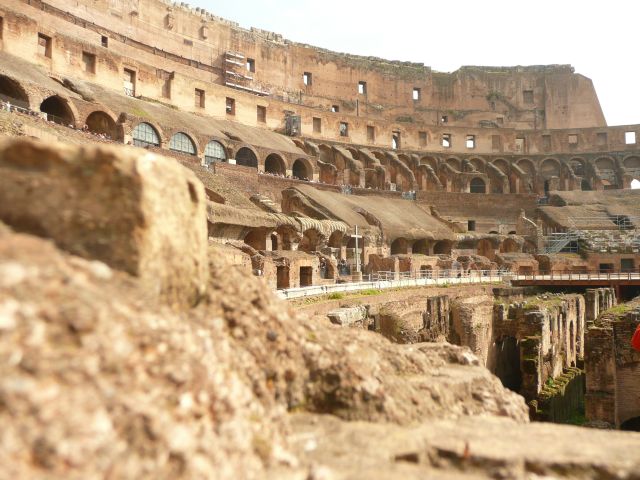
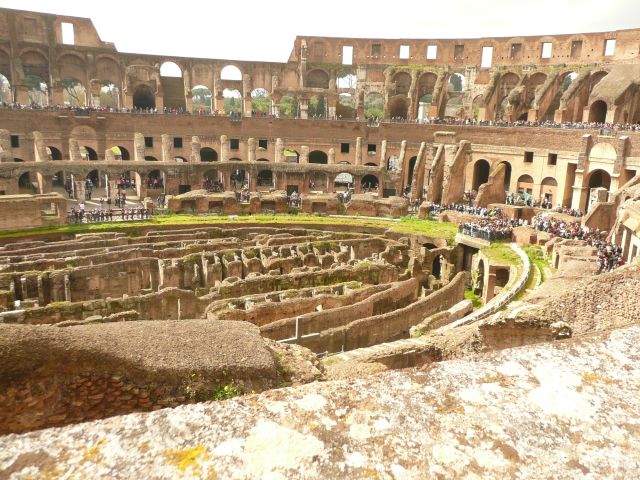
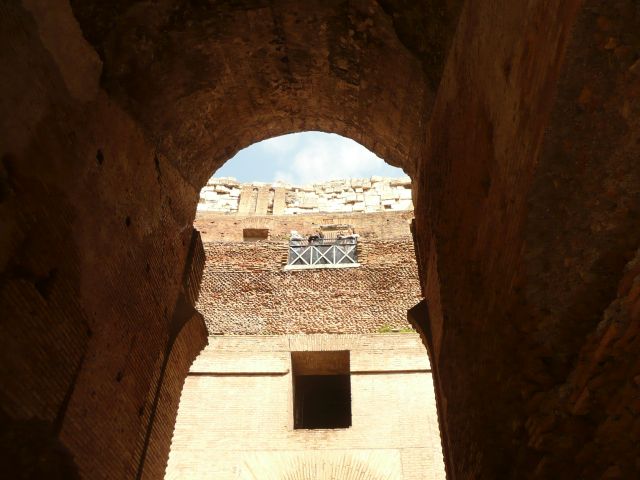
The Colosseum’s current, partially ruined appearance is not solely due to the passage of time. Over the centuries, earthquakes and extensive stone looting caused significant damage, as many of its stones were reused in other buildings during the Middle Ages.
Tickets and practical tips: The Colosseum is one of Rome’s most visited attractions, so if you plan to go inside, it’s highly recommended to purchase tickets online in advance, especially during peak season or on weekends. We found that booking through platforms like Tiqets or GetYourGuide is the easiest way to secure skip-the-line entry and combined passes for the Forum and Palatine Hill.
Tickets are often sold as combined passes, which include entry to the Colosseum, the Forum Romanum, and Palatine Hill – all central sites of ancient Rome. When traveling with young children, it’s worth considering in advance how much you can realistically fit into a single day, as the area is vast and involves a lot of walking.
The Forum Romanum was the political, religious, and social center of ancient Rome – essentially the equivalent of a modern city center, where all major events took place. Public speeches, celebrations, processions, and everyday life all unfolded here.
The Forum is still under archaeological excavation today, so during a visit you’re not only seeing remnants of the past but also an active archaeological site.
Even without an entry ticket, there is a beautiful view of the ruins from nearby areas and from Palatine Hill: temples, triumphal arches, and columns are clearly visible from the outside.
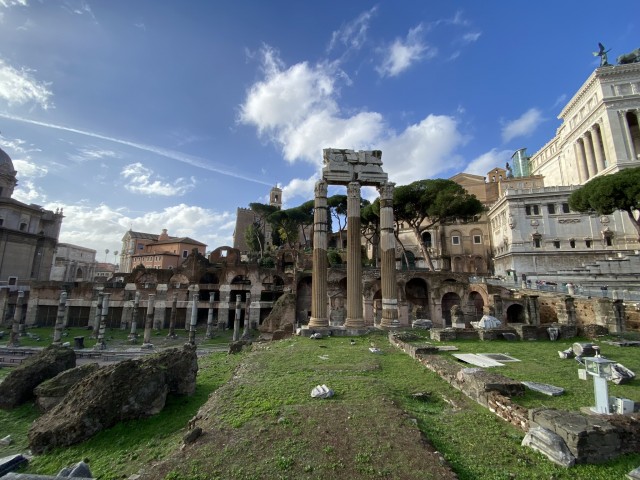
Those who wish to explore the Forum more closely and in greater detail can do so with the combined Colosseum ticket, which also includes access to the Forum Romanum and Palatine Hill.
An Imaginary Journey into Ancient Rome
It’s fascinating to imagine what life was like here thousands of years ago: bustling markets, public speeches, celebrations, and grand processions. Even when traveling with a young child, it can be a lovely experience to talk about all this – even if we’re only exploring the ruins from the outside.
Helpful tip: it’s worth looking at a few pictures or illustrations of ancient Rome in advance. This makes it much easier to imagine what the Forum Romanum looked like in its heyday.
Today, the Forum Romanum is filled with the remains of ruined temples, triumphal arches, and columns that were once parts of vast and imposing buildings. Among them are the Senate House, where Roman politicians made important decisions; the Temple of Vesta, where the sacred fire guarded by the Vestal Virgins once burned; and Julius Caesar’s tomb, where visitors still leave flowers as a sign of respect.
Right next to the Colosseum and the Forum Romanum lies Palatine Hill, one of the most important sites of ancient Rome. According to legend, this is where Romulus founded Rome, and where the first homes were built, followed later by imperial palaces.
On this occasion, we didn’t walk up Palatine Hill, but it’s good to know that the combined ticket valid for the Colosseum and the Forum Romanum also includes entry to Palatine Hill.
If you have more time in Rome, it’s definitely worth exploring this area as well. Palatine Hill has a much calmer atmosphere than the surrounding landmarks, and the walk is broken up by shaded areas and benches, making it ideal for a short rest during sightseeing.
From the top of the hill, there are breathtaking views over the ruins of the Forum Romanum and the Circus Maximus, which alone make the visit a memorable experience.
Tip for families with young children: some parts are accessible with a stroller, but due to uneven levels and cobblestones, a baby carrier or a lightweight stroller may be more comfortable. To navigate the streets and find the best stroller-friendly routes, having a reliable data connection is essential. Using an e-SIM from Airalo is a great way to stay connected throughout the trip without having to worry about roaming charges.
After walking around the Colosseum, we followed Via dei Fori Imperiali and arrived at Capitoline Hill, once the political and religious center of ancient Rome – and still one of the city’s most important locations today.
At the top of the hill are Rome’s City Hall, the Capitoline Museums, and the famous Piazza del Campidoglio, designed by Michelangelo. We really loved the square’s elegant symmetry, harmonious proportions, and statues.
In ancient times, the Temple of Jupiter, Rome’s most important sanctuary, stood on the Capitoline Hill. The hill symbolized Roman power and divine protection, and this is where the affairs of the empire were governed.
Later, during the Middle Ages and the Renaissance, the Capitoline retained its significance. In the 16th century, Michelangelo redesigned the square, which still reflects his vision today. Piazza del Campidoglio is a unique trapezoidal square, with a copy of the equestrian statue of Marcus Aurelius at its center (the original is housed in the Capitoline Museums).
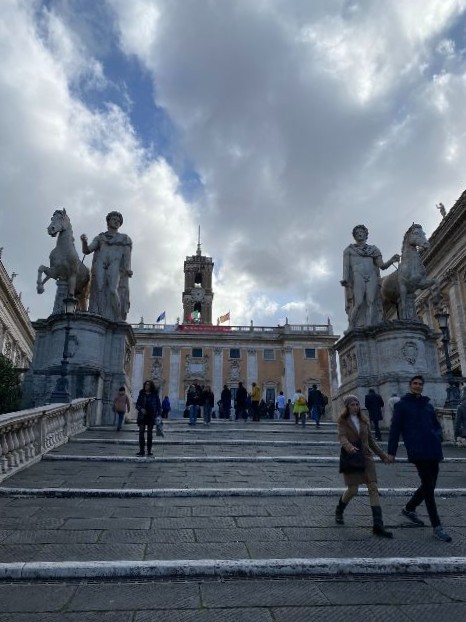
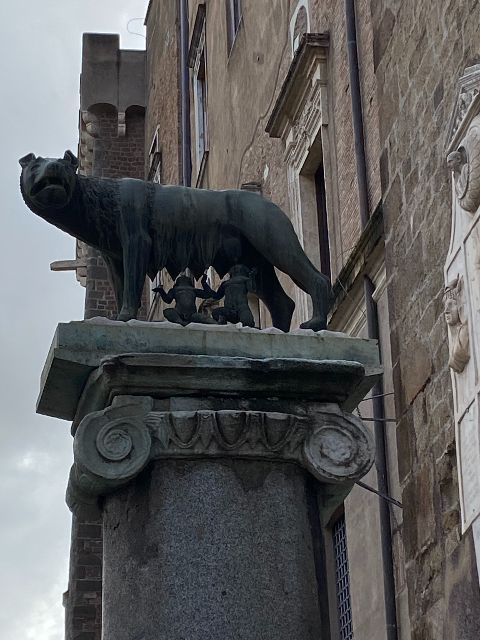
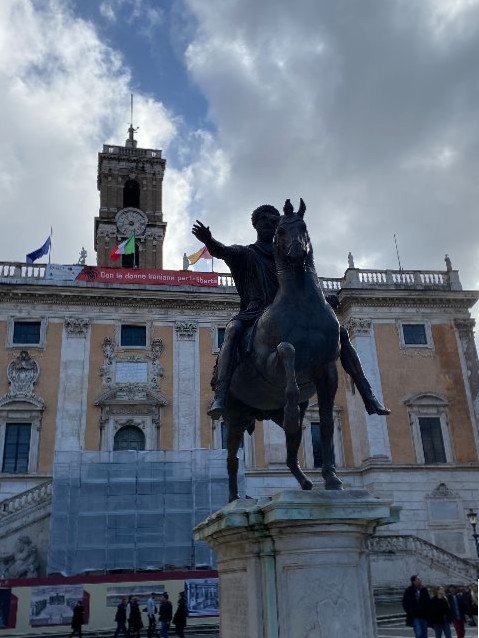
The Capitoline Hill can be reached via stairs or by a gentle incline from Via dei Fori Imperiali – the route we took – making it accessible with a stroller as well. The square was relatively calm and less crowded, so our daughter could get out of the stroller here.
Several noteworthy statues can be found around the square. One copy of the Capitoline Wolf, for example, is located at the back of the square, beside the building on the left-hand side (when facing the building). We took time to see this and the other outdoor statues as we walked around – it’s a truly atmospheric and peaceful spot, well worth lingering in.
From the back of Capitoline Hill, there is a stunning panoramic view of the Forum Romanum ruins. This is one of the best viewpoints in the area and a wonderful opportunity to see the heart of ancient Rome from above – even without an entry ticket.
From Capitoline Hill to Piazza Venezia – A Slow Walk, Big Experiences
After walking around Piazza del Campidoglio, it was already past 11 a.m., so – to avoid rushing – we slowly made our way back toward our accommodation to collect our luggage. Our walk downhill from the Capitoline led us to Piazza Venezia, where we naturally stopped to admire its landmarks once again in daylight.
Piazza Venezia is one of Rome’s most central squares, where several of the city’s main avenues intersect. It’s not only a major traffic hub but also a site of great historical and architectural significance.
The dominant feature of the square is the Vittorio Emanuele II Monument, also known as the Altare della Patria, built in honor of Italy’s first king. The monumental white marble structure, with its vast staircases, columns, and statues, made a truly majestic impression.
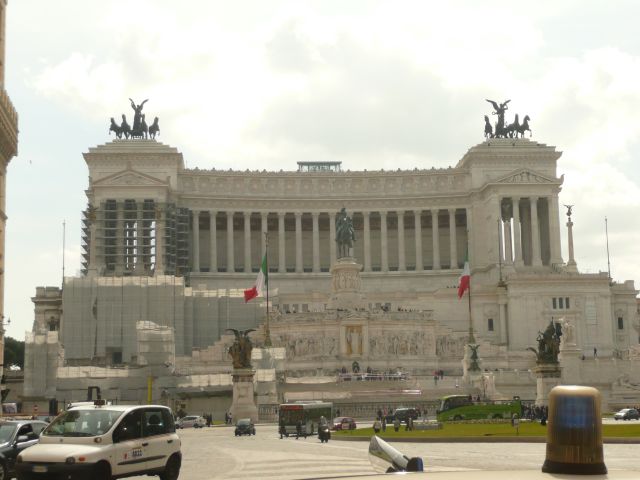
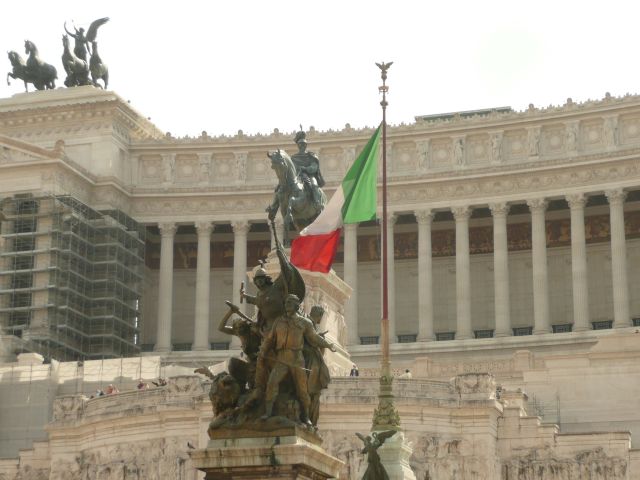
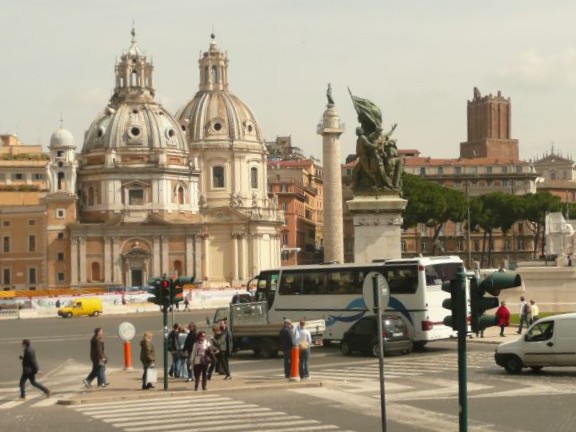
An interesting detail is that you can take an elevator to the rooftop, where a 360-degree panoramic view of Rome awaits – a special experience if you have the time.
The square takes its name from Palazzo Venezia, a Renaissance palace that once served as a papal residence and later housed Mussolini’s office. Today, the building functions as a museum with a variety of interesting exhibitions.
There are numerous cafés and gelaterias around Piazza Venezia, making it a great place for a short break during sightseeing. The square is spacious but extremely busy, so extra attention is needed when visiting with young children.
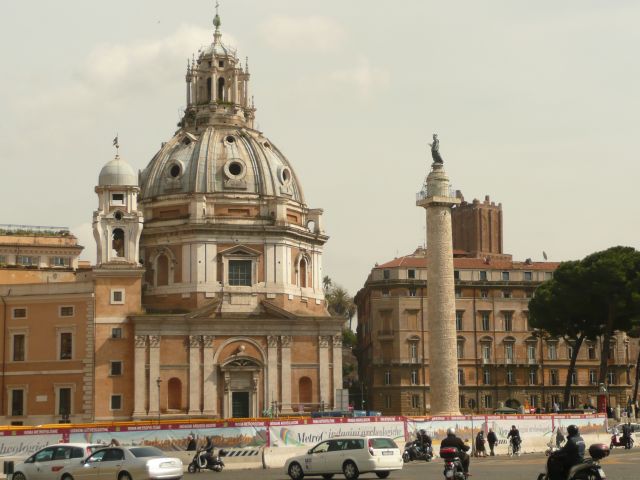
We left Piazza Venezia by walking past Trajan’s Column, which immediately caught our attention from afar. This nearly 39-meter-high monument, carved from white marble, commemorates Emperor Trajan’s Dacian Wars.
For us, the most fascinating feature was the spiraling relief that wraps around the column, depicting more than 2,000 figures. It’s like an ancient comic strip, telling the story of the Dacian campaigns in remarkable detail.
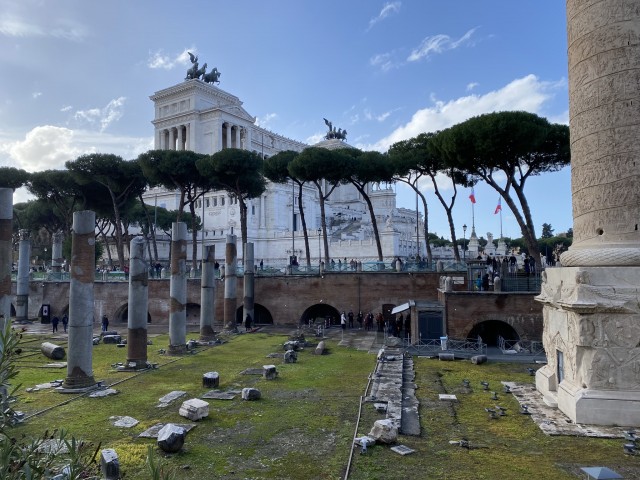
The column is special not only for its historical significance but also because it serves as Trajan’s tomb.
Trajan’s Column can be admired in all its glory from the outside, so it’s well worth stopping here even if you don’t have time for a museum visit or a longer stay.
From here, we headed back toward our accommodation.
After collecting our luggage, we took a train from Termini Station toward the airport. We got off at Ciampino railway station, from where the Ciampino AirLink bus stop is just a three-minute walk away. This small airport shuttle bus took us to Ciampino Airport in just a few minutes.
For family trips like this, we recommend choosing a flexible travel insurance provider like Heymondo or WorldNomads to cover any unexpected hiccups. Our trip was smooth and stress-free, partly because we always travel with peace of mind.
We left behind a wonderful winter city break. This short Roman getaway once again reminded us that it’s not the number of sights but the experiences we live through that truly make a trip memorable. Walking slowly, at stroller-friendly pace, we received so much from Rome.
Some of the links in this post are affiliate links. This means we may earn a small commission at no extra cost to you. This helps support WanderingKite and allows us to continue sharing family travel tips and experiences.
@ Copyright - WanderingKite | All rights reserved! | Privacy Policy