
This post contains affiliate links. Full disclosure at the bottom of the page.
Explore our Day 2 highlights:
Castel Sant’Angelo & The Bridge of Angels
The Spanish Steps & Trevi Fountain by Night
We started our day with a metro ride in the morning. Our first destination was Vatican City. Vatican City is the smallest independent state in the world, located in the heart of Rome, and it is the centre of the Catholic Church and the residence of the Pope. As this part of the city was a bit farther from our accommodation—and we woke up to rainy weather that morning—we decided to use public transport.
As we stepped out of our accommodation, we quickly bought an umbrella and a rain poncho, settled our daughter into her stroller, and fitted the rain cover we had brought along. That’s how we set off towards the nearest metro station.
Luckily, the rain fell in a very “Roman” way: a short 5–10 minute shower, followed by up to an hour of dry weather, then another brief downpour—and another long pause. At first, I was a little grumpy about the rain, but in this form it later became hardly bothersome.
Tip: In Rome, rain gear such as umbrellas and ponchos is sold on almost every corner, so it’s not really worth packing these specifically. The quality can vary—perfect as a quick solution, but less ideal for long-term use.
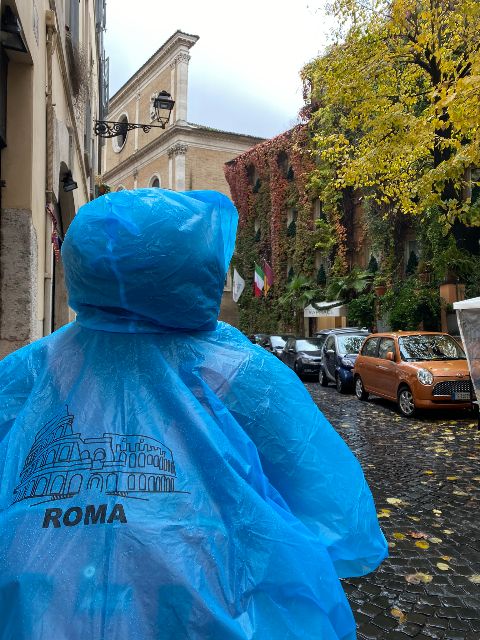
Getting to the Vatican – By Metro and on Foot
We travelled from Termini Station on the red metro line (Line A) all the way to Ottaviano station. The metro is generally stroller-friendly, although the lifts don’t always work perfectly everywhere, so it’s worth allowing extra time. From Ottaviano, we continued on foot. The walk was short and pleasant. Navigation was super easy since we had local data through our Airalo eSIM.
A Morning Stop at a True Italian Bakery
Along Via Ottaviano, we stopped at a real hidden gem: Parenti Bakery, where we grabbed a quick breakfast and coffee. This is an authentic local Italian bakery. The coffee was excellent, the pistachio croissant was absolutely divine, and the counter was filled with fresh pastries and sandwiches.
There’s no seating inside—this is a classic Italian “standing coffee” spot. Locals drink their coffee at the counter or take it outside, where public benches can be found nearby. As we arrived in the Vatican area early in the morning, before the big crowds, it was the perfect place for a quick takeaway breakfast and a good coffee before continuing our walk.
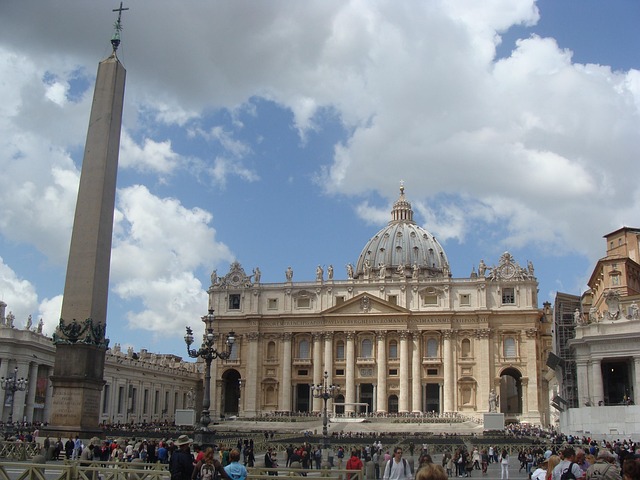
After breakfast, we soon found ourselves in St Peter’s Square. My husband had never been here before, so we spent a few minutes simply standing there, taking in the view and trying to process everything we knew about the square.
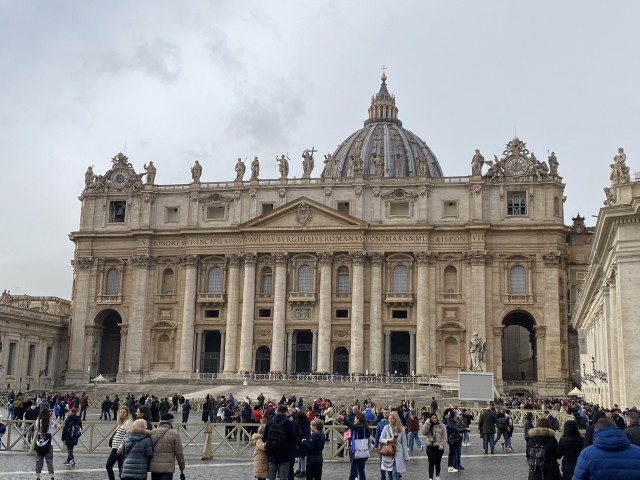
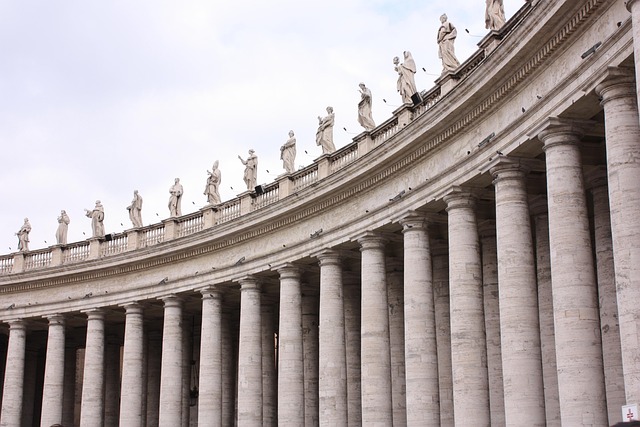
The square was designed by Gian Lorenzo Bernini, with one main purpose in mind: to allow as many people as possible to attend papal masses and blessings. As a result, the square is enormous, yet perfectly harmonious.
Bernini also masterfully played with optical illusion: as you walk towards the basilica, the building can appear to move slightly farther away. Although it looks circular at first glance, the square is actually elliptical in shape. The Egyptian obelisk standing at its centre has been here since 1586. The obelisk itself is over 4,400 years old and was relocated three times before reaching its current position.
St Peter’s Square is very stroller-friendly: spacious, easy to navigate, and equipped with public toilets.
St Peter’s Basilica (Basilica di San Pietro in Vaticano) is a Renaissance masterpiece and the most important building in Vatican City. Its monumental scale and massive dome dominate Rome’s skyline—and seeing it in person is almost impossible to put into words.
When Is the Best Time to Visit?
One of the keys to visiting the basilica is arriving early. Security checks are mandatory, and long, winding queues often form at the entrance.
It’s best to arrive between 7:30 and 8:30 am, when crowds are still relatively small—especially important when visiting with a young child.
Arriving early also makes moving around with a stroller much easier, and the interior of the basilica can be enjoyed in a calmer atmosphere.
Although we didn’t enter the basilica on this occasion, I had visited it previously and was able to admire its interior then. Just inside on the right-hand side is Michelangelo’s world-famous Pietà, which alone is worth the visit.
Climbing the Dome – Panoramic Views of Rome
It’s also possible to climb the dome of St Peter’s Basilica, designed by Michelangelo. The ascent includes a lift for part of the way, followed by 320 steps to the top. The reward is a breathtaking panoramic view over Rome and Vatican City.
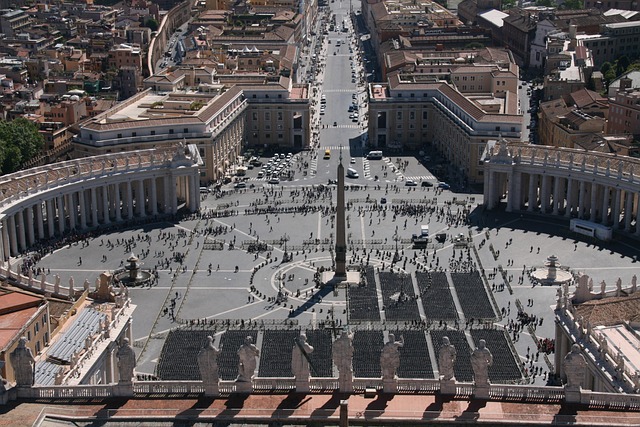
One of the most special moments of the climb is seeing the basilica’s interior and ceiling from very close up.
The staircases leading to the dome are narrow and winding, making them difficult with a small child. It’s best planned in turns or with a baby carrier.
Entrance Fees (2025) – St Peter’s Basilica & Dome
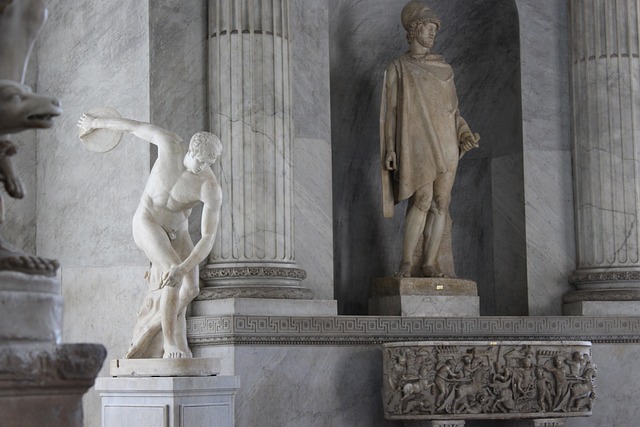
The Vatican Museums form one of the most important museum complexes in the world and include the famous Sistine Chapel with Michelangelo’s breathtaking frescoes.
With a young child, this can be a long and crowded visit, so we decided to skip it. However, if you have the time and energy, it’s definitely worth booking tickets in advance, as queues are often very long. With a stroller and small children, the visit can be quite demanding, but with older children it can be an enriching and fascinating experience.
Ticket Purchase – What You Should Know in Advance
Crowds at the Vatican Museums are almost guaranteed, so buying tickets online in advance is strongly recommended.
Tickets can be purchased:
Online tickets not only save time but also secure entry at your preferred time slot—especially important during peak season.
Entrance Fees (2025) – Vatican Museums & Sistine Chapel
Even though we didn’t enter either the basilica or the museum, we spent about an hour in this area simply exploring the surroundings and walking around the square. Luckily, the rain stayed away during this time, so we could stroll at a relaxed pace, look around, and stop for a few photos.
Extra Experience: Rome’s “Keyhole” View
If you walk towards the Aventine Hill, don’t miss the famous Roman keyhole.
Through the gate at Piazza dei Cavalieri di Malta (the headquarters of the Knights of Malta), you’ll see a perfectly framed view of St Peter’s Basilica’s dome—a small but unforgettable Roman surprise.
We set off toward Castel Sant’Angelo along Via della Conciliazione – the “Road of Reconciliation.” This wide, straight boulevard starts near Castel Sant’Angelo and leads directly to St. Peter’s Square, the main entrance to Vatican City.
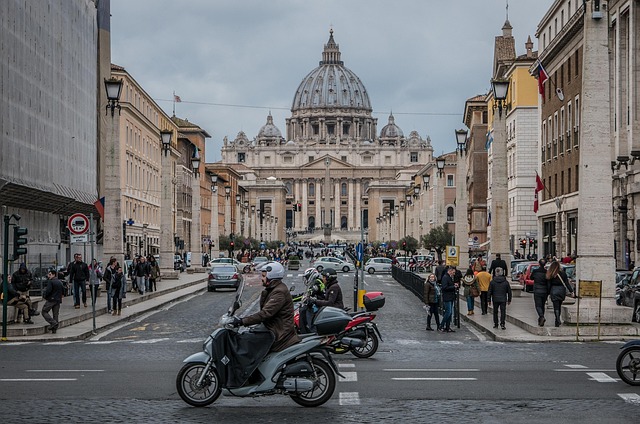
The avenue was designed after the Lateran Treaty of 1929, which officially recognized the independence of Vatican City. Its name refers to the reconciliation between the Holy See and the Italian state. It is particularly comfortable and easy to navigate with a stroller, making it an excellent choice for families traveling with young children.
A brief history of Castel Sant’Angelo
Castel Sant’Angelo was originally built as a mausoleum for Emperor Hadrian and his family. Over the centuries, its function changed several times: for nearly a thousand years it served as a fortress and defensive stronghold, and since 1901 it has been open to the public as a museum.
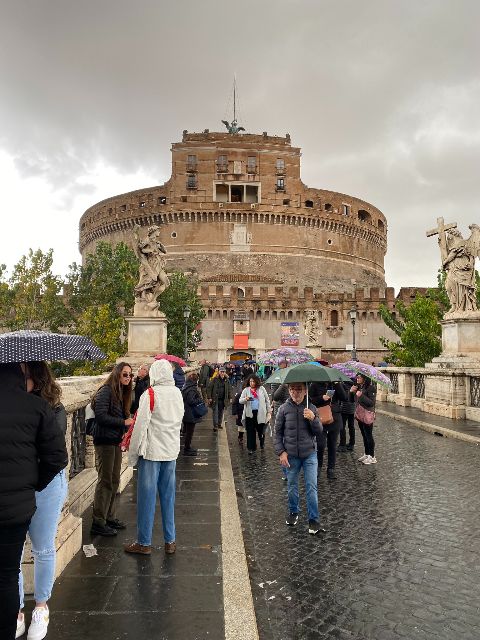
The castle is connected to the Vatican by a covered corridor known as the Passetto di Borgo, which served as an escape route for popes in times of danger. In the 16th century, a chapel was also added to the building.
Inside the museum, visitors can see the papal apartments, a torture chamber in the lower levels, and a remarkable collection of weapons. The fortress takes its name from the angel statue standing on its roof.
Extra experience: From the top, there is a stunning 360-degree panoramic view over Rome and Vatican City – one of the most beautiful viewpoints in the city.
As we walked past Castel Sant’Angelo, we were suddenly caught in a heavy downpour. Fortunately, it only lasted a few minutes and cleared just as quickly as it had arrived.
In Rome, rain is often intense but short-lived – a poncho or a stroller rain cover is truly invaluable.
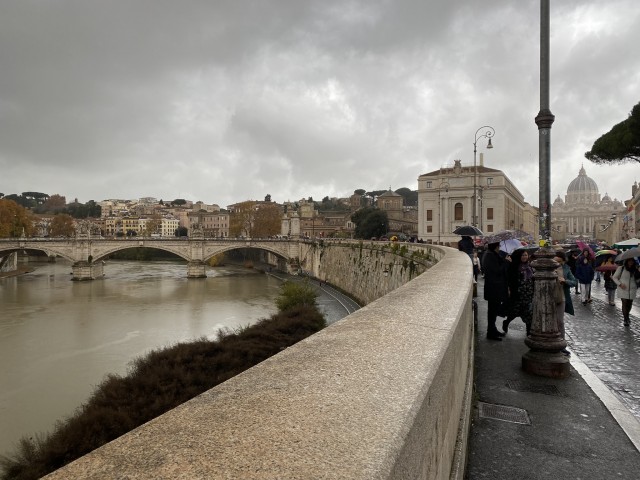
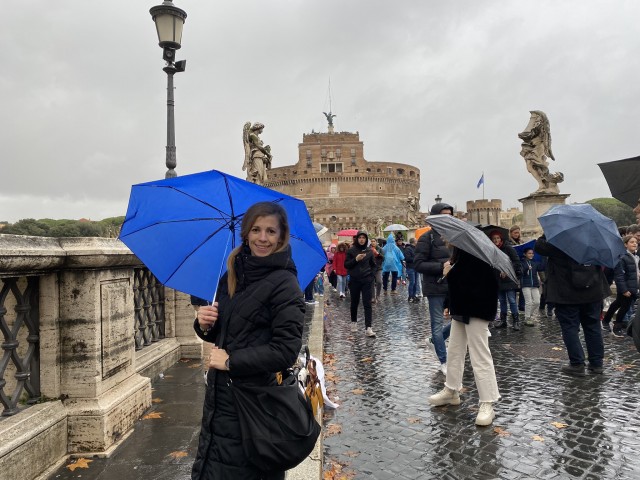
Ponte Sant’Angelo – one of Rome’s most beautiful bridges
We crossed back to the other side of the Tiber via Ponte Sant’Angelo, the bridge leading to Castel Sant’Angelo. Many consider it the most beautiful bridge in Rome – and it’s easy to see why.
The bridge itself was commissioned by Emperor Hadrian and is impressive in its own right. Along the bridge stand statues of Saints Peter and Paul, as well as ten angel figures. It’s worth noting that the angel statues were not part of the original bridge – they were added in the 17th century and are the work of Gian Lorenzo Bernini and his students.
The bridge is wide and easy to walk across with a stroller, very pedestrian-friendly, and also one of Rome’s most popular photo spots. As a result, it was quite crowded even on this December day. By the time we reached the other side of the bridge, the rain had finally stopped, and from here we continued our walk toward the Spanish Steps.
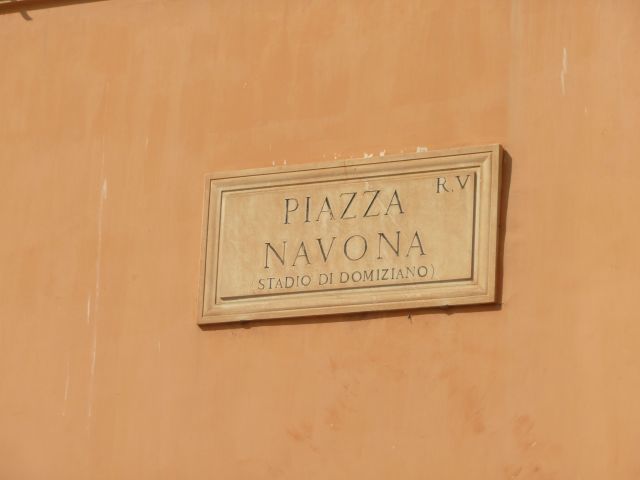
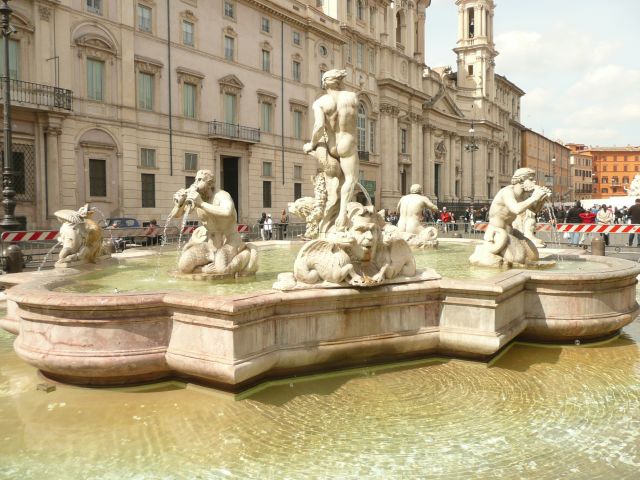
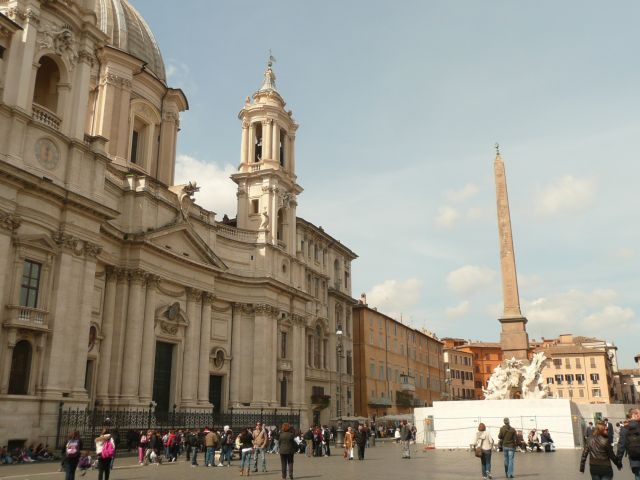
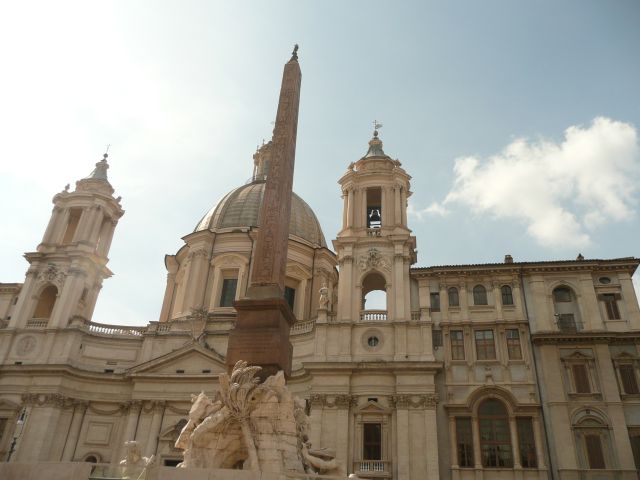
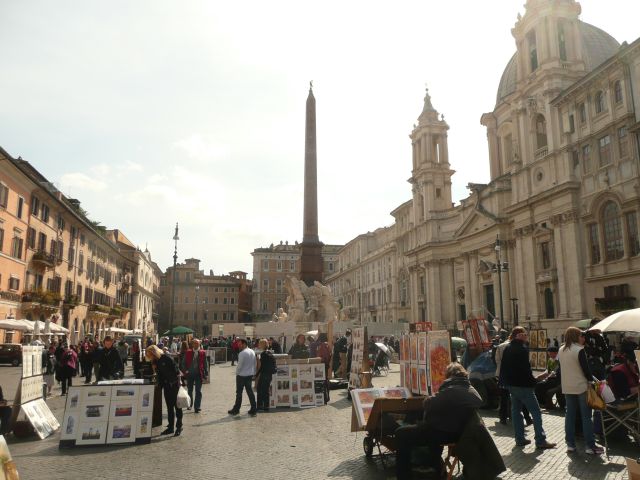
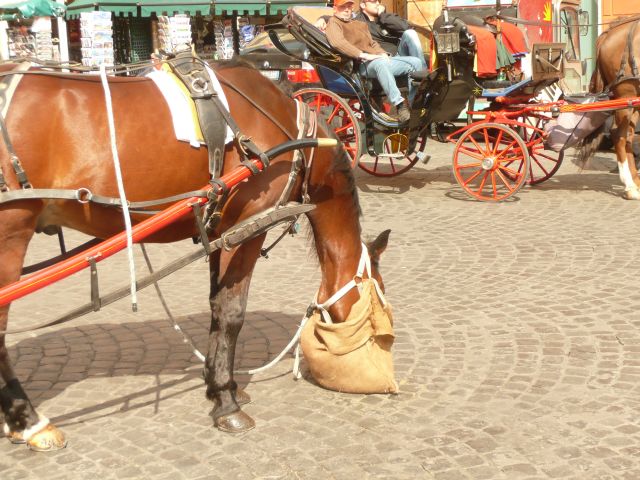
In the heart of Rome, it’s simply impossible to walk past beauty without stopping. Although we had already paused at Piazza Navona the evening before, it was on our route again, so this time we spent a little while here in daylight. It revealed a completely different face compared to the evening – and it’s absolutely worth visiting at both times of day. During this time, our daughter slept wonderfully in the stroller for more than an hour.
A sweet stop: Gelateria Della Palma
When she woke up, we stopped at Gelateria Della Palma. We had already been here the night before for dessert after dinner, so it felt like a natural choice once again. We enjoyed a coffee and some pancakes, and it was a real bonus that my husband could also choose from the dairy-free options – a huge plus for anyone traveling with food intolerances.
After a short rest and a bit of recharging, we continued our walk toward the Spanish Steps, feeling refreshed and energized. For us, these small pauses are what truly complete a trip. They’re not only about resting, but about those tiny yet meaningful moments that make sightseeing truly memorable. Travel, after all, isn’t just about getting from point A to point B – it’s also about slowing down, being present, and wandering until you find the magic in the moments.
Along the way, we were once again caught by a sudden rain shower – thankfully, it lasted only a few minutes this time as well. We took shelter under a nearby awning and waited for the rain to pass. These little forced pauses became part of the rhythm of our Roman walk.
As soon as the sky cleared, we arrived at the Spanish Steps. This impressive Baroque staircase connects Piazza di Spagna with the Trinità dei Monti church at the top of the hill. With its 138 elegant steps, it’s not only an architectural masterpiece but also one of Rome’s most beloved meeting and resting spots.
From the top, there’s a beautiful view over the city, while below, life buzzes with energy: street musicians, strolling tourists, and families wandering by with gelato in hand – even in December. The surrounding area is full of cafés, gelaterias, and boutiques, making it an ideal stop during a city walk, even when traveling with young children.
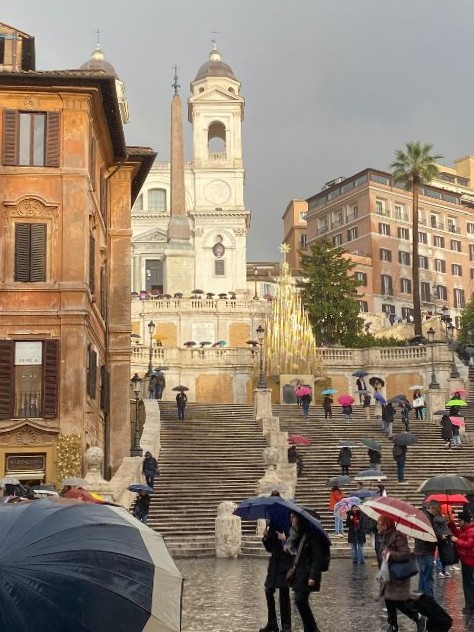
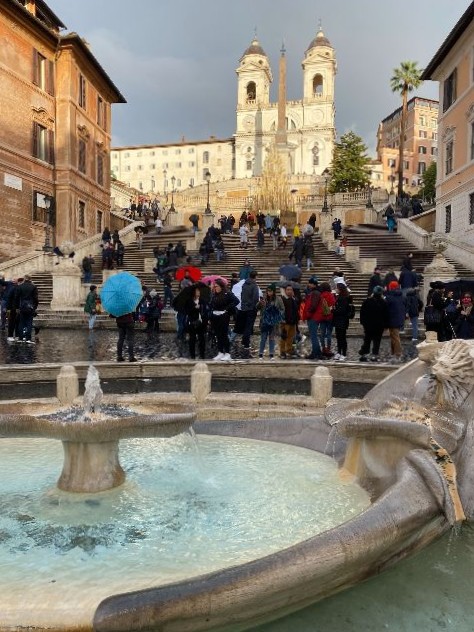
The Spanish Steps take their name from the Spanish Embassy located on the square, which has been based here since the 17th century. The construction of the staircase was funded by a French diplomat, Étienne Gueffier, with the aim of creating a dignified connection between the square and the church on the hillside.
The shape of the staircase resembles open arms, as if embracing the square and those arriving there – it truly has a special atmosphere.
Fontana della Barcaccia – Bernini’s unique fountain
At the bottom of the steps stands the Fontana della Barcaccia, a distinctive Baroque fountain shaped like a sinking boat. It was created by Pietro Bernini and his son, Gian Lorenzo Bernini.
It’s important to note that since 2019, sitting on the steps of the Spanish Steps has been prohibited, and fines of up to €400 can be imposed for breaking the rules. The restriction aims to protect the monument and reduce the impact of overtourism, so it’s worth keeping this in mind.
We spent a little more time on the square: I walked all the way up to the top of the steps, while my husband stayed below with the stroller, and our daughter played near the fountain. After that, we made our way back via the lively Via del Corso shopping street. Along the way, we stopped for dinner – slowing down felt especially good after another day filled with experiences.
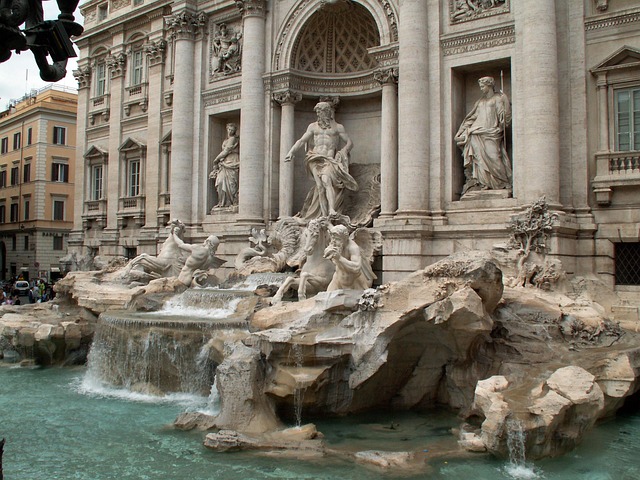
After dinner, we made a small detour to see the Trevi Fountain illuminated in the evening light. The atmosphere was truly special, and we happily lingered there for a while. You can read more about this iconic Roman landmark in the previous day’s summary.
Finally, strolling through Rome’s beautiful streets, we slowly headed back to our accommodation, leaving behind yet another memorable day in the city.
Some of the links in this post are affiliate links. This means we may earn a small commission at no extra cost to you. This helps support WanderingKite and allows us to continue sharing family travel tips and experiences.
@ Copyright - WanderingKite | All rights reserved! | Privacy Policy